
How Much Does a New Septic System Cost in Tennessee?
Published national cost guides put a new septic system between about $3,100 and $12,500 installed. The averages those guides report sit near $6,400 to $8,000. A basic conventional system on ground that drains well lands at the low end. An alternative system on tight clay or shallow rock can pass $15,000.
Tennessee does not publish a statewide average install price. It does publish its permit fees, and those are firm. The state charges $400 for a new conventional septic permit and $500 for a new alternative system permit.
Everything below comes from published national cost guides and from the state of Tennessee. These figures are market numbers, not our price list. We give free estimates on septic tank installation, and your real number comes from your soil and your site.
What is the average cost of a septic system install?
Two large national cost guides publish figures that line up fairly well. One lists a national average of $6,361, with a typical range of $3,109 to $9,677. The other lists an average of $8,019, with a normal range of $3,589 to $12,463. Both show high-end jobs climbing past $18,000.
Those totals cover the whole system. That means the tank, the drain field, the line between them, the excavation and the backfill. The tank by itself is a smaller piece of the bill than most people expect.
What does a septic system cost by system type?
| System type | Published market range |
|---|---|
| Conventional (tank plus gravel trench field) | $3,500 to $10,000 |
| Chamber (gravelless field) | $5,000 to $12,000 |
| Sand filter | $6,000 to $18,000 |
| Pressure distribution | $7,000 to $10,000 |
| Drip distribution | $8,000 to $18,000 |
| Mound system | $10,000 to $20,000 |
| Aerobic treatment unit | $10,000 to $20,000 |
Those ranges come from two published national cost guides. Where the two guides differ, the table shows the full span. The design itself moves the price more than any other single choice.
Why does an alternative system cost more?
A conventional system runs on gravity. Water leaves the tank and soaks into trenches cut in soil that drains well. The EPA describes this as a tank plus a trench or bed drain field. It calls the gravel version the standard design for decades.
When soil will not take water, the design has to change. The EPA notes mound systems are used where soil is shallow or bedrock sits near the surface. High groundwater causes the same problem. Sand filters treat to a higher level, and the EPA says they cost more than conventional systems.
Middle Tennessee hits several of those triggers. Heavy clay drains slowly. Limestone bedrock often sits only a few feet down. Bottomland near the Cumberland, Red and Harpeth rivers carries a high water table in wet years.
What drives the price on your property?
Soil and the site evaluation. This is the first real cost, and it sets everything after it. Tennessee runs its program on a soil site evaluation rather than a simple perc test. The state publishes a list of approved soil consultants who do that work. National guides put soil and site testing at $700 to $2,000.
System size. Tennessee sizes a permit by gallons per day of flow. The application asks for bedroom count, occupancy, lot size and water use. Guides list a 1,000 gallon tank for a three or four bedroom home at $900 to $1,500. A 1,500 gallon tank runs $1,500 to $2,500.
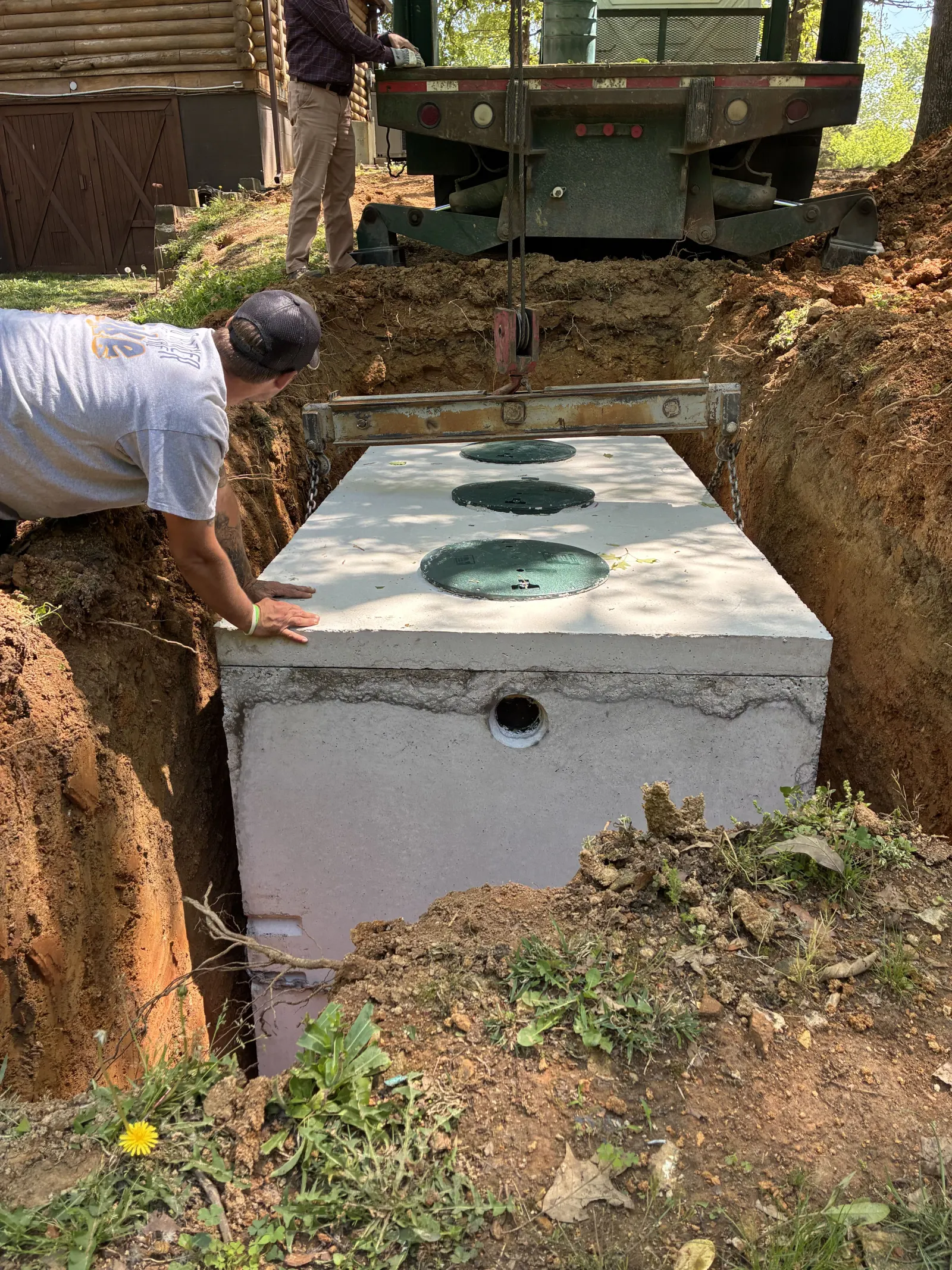
Site access. A precast concrete tank arrives on a truck and gets set with a boom. If the truck cannot get close, the work takes longer. Slope, trees, wells, springs, driveways and buried utilities all shape where the field can go. Published guides put excavation labor alone at $1,500 to $6,300.
The drain field. This is usually the largest single line on an estimate. Published ranges run $2,000 to $12,000 for a field. On an older home, a drain field replacement often costs more than the tank that feeds it.
What does the Tennessee septic permit cost?
Septic permits in Tennessee go through the Department of Environment and Conservation, Division of Water Resources. The state calls them subsurface sewage disposal permits. Here is the fee schedule it publishes.
| Tennessee permit or inspection | Published fee |
|---|---|
| New conventional system, up to 1,000 gallons per day | $400 |
| Each additional 1,000 gallons per day of flow | $100 |
| New alternative system, up to 1,000 gallons per day | $500 |
| Each additional 1,000 gallons per day of flow | $150 |
| Construction inspection, conventional | $100 |
| Construction inspection, alternative | $200 |
| Repair permit | No fee |
| Repair construction inspection | $100 |
The application asks for lot size, bedroom count, occupancy, water use and basement information. It also asks for a sketch showing property lines, the house site, the well, any spring, the driveway and utilities. Larger systems and alternative systems need a design from a licensed engineer.
The state says review generally takes about 10 days. It must be completed within 45 days of the date the application was submitted. Nine Tennessee counties run their own program and may require a second local permit. Davidson County is on that list, so a Nashville job can carry an extra step.
Is replacing only the septic tank cheaper?
Usually, yes. Swapping the tank skips the most expensive part of a full install. Published guides put a tank replacement at $3,000 to $10,000, against $3,589 to $12,463 for a complete new system.
Whether you can replace only the tank depends on the field. If the field still takes water, a new tank and fresh plumbing may be all you need. If the field is saturated, a new tank will not fix it. A septic inspection sorts that out before you commit to a number.
Getting a real number for your lot
Market ranges are a fine starting point for a budget. Your actual quote comes from your soil report, your bedroom count, your lot and your county.
Wiley Rooter and Septic Pros is based in Greenbrier, Tennessee, and works the north side of the Nashville area. The company brings 20 years of septic and sewer experience to new septic systems and tank replacements. Our crew handles its own excavation and sets precast concrete tanks with a boom truck. Estimates are free. Call or text (629) 285-6381.